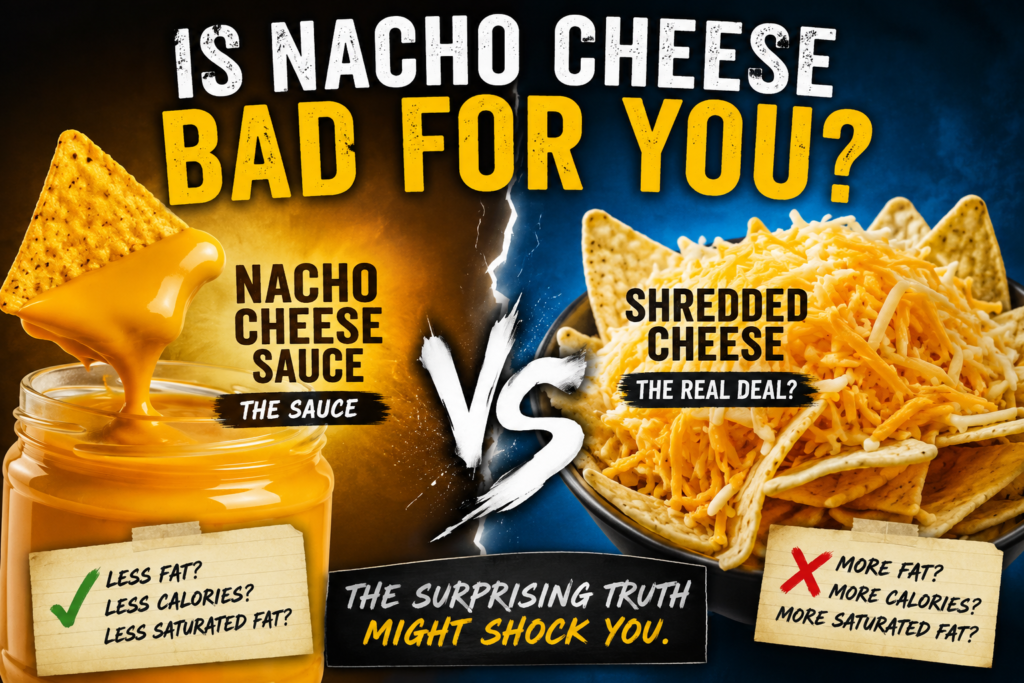
Nacho cheese has never enjoyed a reputation as a health food.
Nobody finishes a plate of loaded nachos, wipes the fluorescent orange evidence from their fingers and says, “Excellent. That should really improve my cardiovascular profile.”
But is nacho cheese actually as bad for you as people assume?
Years ago, I decided to investigate by comparing three products available at my local grocery store:
- Frito-Lay jarred cheese dip
- Tostitos jarred nacho cheese dip
- Kraft shredded Mexican-style cheese
The original results appeared to show that jarred nacho cheese sauce was substantially healthier than ordinary shredded cheese.
That conclusion was surprising.
It was also a little more complicated than I originally made it sound.
The Original Nacho Cheese Experiment
Back in 2008, we wanted to compare the amount of each product that someone might realistically use during one serious encounter with nachos.
For the two cheese sauces, we used approximately six tablespoons.
For the shredded cheese, we used approximately one cup.
The jarred sauces contained considerably fewer calories, less total fat and less saturated fat than the cup of shredded cheese.
At first glance, the winner appeared obvious:
A jar of nacho cheese sauce had defeated real shredded cheese in a nutritional upset for the ages.
But there was a flaw in that conclusion…
Why the Comparison Is Not Quite Apples to Apples
Jarred nacho cheese sauce and shredded cheese are not nutritionally equivalent products.
Shredded cheese is concentrated cheese. Jarred cheese dip usually contains cheese along with water, oils, milk ingredients, peppers, starches and other ingredients that create its smooth consistency.
In other words, comparing a cup of shredded cheese with several tablespoons of cheese sauce is somewhat like comparing concentrated orange juice with an orange-flavored beverage.
The sauce may contain fewer calories because a significant portion of it is water and other lower-calorie ingredients. That can still be useful if it allows you to cover your nachos with less fat and fewer calories—but it does not automatically make the sauce more nutritious.
So, Is Nacho Cheese Bad for You?
Nacho cheese is not inherently poisonous, medically sinister or capable of destroying an otherwise reasonable diet.
However, most commercial nacho cheese sauces have several nutritional weaknesses:
It Can Be High in Sodium
Processed cheese dips commonly contain a substantial amount of sodium in a relatively small serving.
This becomes more important because the cheese is rarely eaten alone. Tortilla chips, seasoned meat, beans and other nacho toppings can add even more sodium.
The entire plate matters more than the cheese by itself.
It May Contain Significant Saturated Fat
Both natural cheese and processed cheese sauce can contain saturated fat.
Shredded full-fat cheese will usually contain more saturated fat per cup because it is more concentrated. Cheese sauce may contain less per tablespoon, but generous portions can still add up quickly.
It Is Easy to Eat More Than One Serving
The serving size printed on a jar of cheese dip is not necessarily the amount a person actually eats.
Two tablespoons may be a legally recognized serving.
It is not necessarily a spiritually recognized serving.
Anyone evaluating the nutrition label should multiply the numbers by the amount they realistically consume.
Is Jarred Nacho Cheese Healthier Than Shredded Cheese?
It depends on what you mean by “healthier.”
Jarred cheese sauce may be better when you want:
- Fewer calories per spoonful
- Less total fat per typical portion
- Less saturated fat than a heavy layer of shredded cheese
- Maximum cheese coverage with a smaller amount of actual cheese
Shredded cheese may be better when you want:
- More protein
- More calcium
- A shorter and simpler ingredient list
- Greater nutritional value per ounce
- Actual cheese rather than a cheese-based sauce
Jarred cheese sauce can therefore be the lower-calorie option without necessarily being the more nutritious option.
Those are not the same thing.
What About Cholesterol?
The original experiment placed considerable emphasis on dietary cholesterol.
Current nutrition guidance focuses more heavily on the overall eating pattern and on limiting saturated fat and sodium. A food containing more dietary cholesterol is not automatically less healthy than a cholesterol-free processed food.
That means the zero-cholesterol result from one of the jarred sauces is interesting, but it should not decide the entire contest.
Even a cheese-colored substance that contains no cholesterol has not automatically earned a medical degree.
How to Make Nachos Healthier Without Ruining Them
A healthier plate of nachos does not require replacing the cheese with sadness.
Try these adjustments:
- Use a measured amount of cheese instead of pouring until the chips disappear.
- Combine cheese sauce with salsa to increase coverage without adding as much cheese.
- Add black beans or grilled chicken for protein.
- Use tomatoes, onions, jalapeños and peppers for additional flavor.
- Choose lower-sodium chips or use fewer chips.
- Serve guacamole in a reasonable portion.
- Avoid stacking multiple salty meats, sauces and cheeses on the same plate.
The best strategy is usually not finding a magical healthy nacho cheese. It is controlling the portion and improving the rest of the nachos.
The Final Verdict
Is nacho cheese bad for you?
Not automatically.
Jarred nacho cheese sauce can contain fewer calories and less saturated fat than the amount of shredded cheese someone might otherwise melt over the same plate. That makes it a potentially useful option for portion-conscious nacho construction.
However, jarred cheese sauce is often highly processed, can be high in sodium and generally provides less protein and calcium than natural cheese.
Therefore, the scientifically responsible conclusion is:
Jarred nacho cheese sauce may be lighter than a large serving of shredded cheese, but neither product becomes a health food simply because it is placed on a tortilla chip.
Enjoy it in moderation, read the label and remember that the greatest nutritional threat may not be the cheese.
It may be the fact that nobody has ever voluntarily stopped eating nachos after six chips.
Frequently Asked Questions
Is nacho cheese real cheese?
There is no single standardized variety called “nacho cheese.” Commercial nacho cheese sauce usually contains some real cheese or cheese ingredients, but it may also include water, oils, starches, milk ingredients, peppers, flavorings and stabilizers. Recipes vary considerably by brand.
Is nacho cheese high in calories?
It can be, but many jarred cheese sauces contain fewer calories per tablespoon than shredded cheese because they contain more water and other ingredients. Portion size remains critical.
Is nacho cheese high in sodium?
Many commercial nacho cheese sauces are relatively high in sodium. Check the label and account for the sodium in the tortilla chips and other toppings as well.
Is shredded cheese healthier than nacho cheese sauce?
Shredded cheese generally provides more protein and calcium and may have a simpler ingredient list. Nacho cheese sauce may contain fewer calories and less saturated fat per typical serving. Neither is universally healthier in every situation.
Can nachos be part of a healthy diet?
Yes. Portion size, frequency and the complete ingredient combination matter. Nachos made with beans, vegetables, moderate cheese and a controlled amount of chips can fit into an otherwise balanced diet.
This article is intended for general informational and nacho-related entertainment purposes. Nutrition varies by product, and anyone with specific dietary or medical requirements should follow advice from a qualified healthcare professional.
 If you were at least 14 years old between the years 1993 and 1997 then you definitely remember
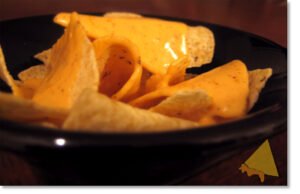
 GDC2007 has come and gone. Overall, it was a decent show…albeit, one without nachos conveniently available in the convention center. However, in response to
 I’m going to pose a question that has come up during some casual conversations with friends of mine.
  Have you ever wondered how many orders of Taco Bell nachos it would take to fulfill your daily recommended amount of Vitamin C? Well we have, and thanks to the Taco Bell Nutrition Calculator over at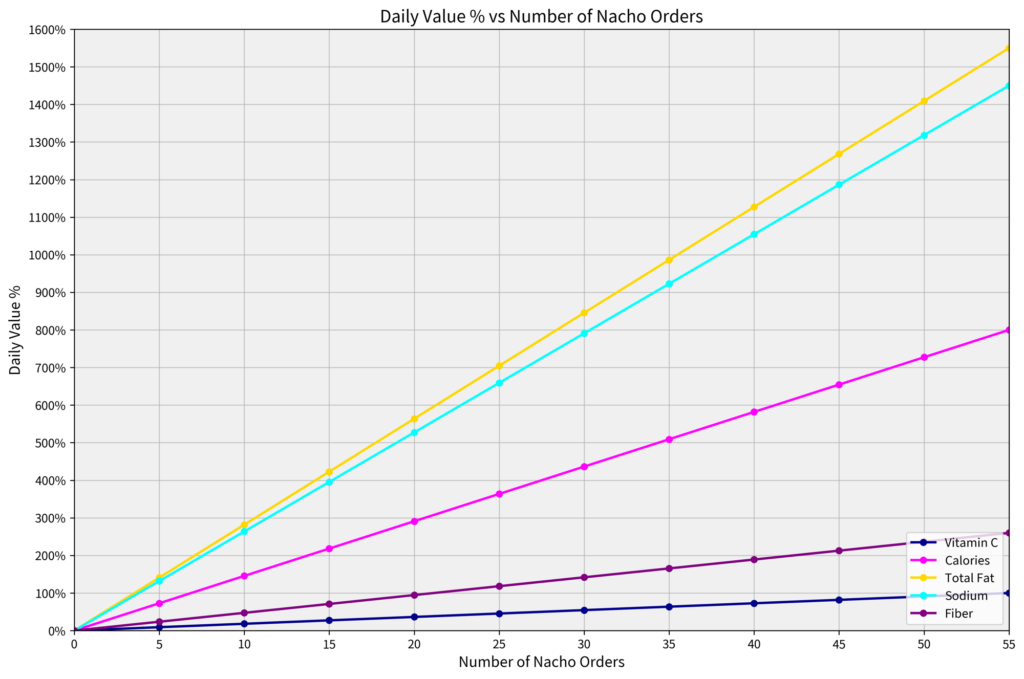

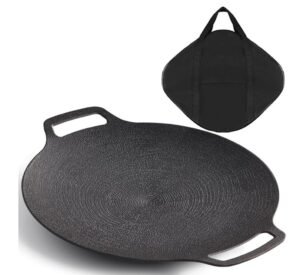 Long story short, the nachos turned out great. Unfortunately I didn’t snap any photos, we ate the nachos too fast. Added bonus…this is a multi purpose BBQ tool, you can cook a of different foods on the bbq using this.
 We recently
  Earlier this month, Dane Boedigheimer of
 Eric is proving to be a true ILoveNachoCheese.com Superfan. First he sends us “
 Sports fans in Nashville may want to think twice before purchasing nachos at the Nashville Arena concession stand. After four years of health inspections, unsafe food and a rodent problems were revealed that the Health Department called “critical violations.” In addition to 22 cases of mouse droppings in concession stands, since 2003, inspectors found out that 15 pounds of nacho cheese had to be thrown out because they were stored at the wrong temperature.
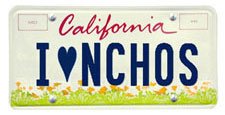 You may be surprised to learn that I’m not the owner of this license plate, nor are any of the other authors here at ILoveNachoCheese.com.